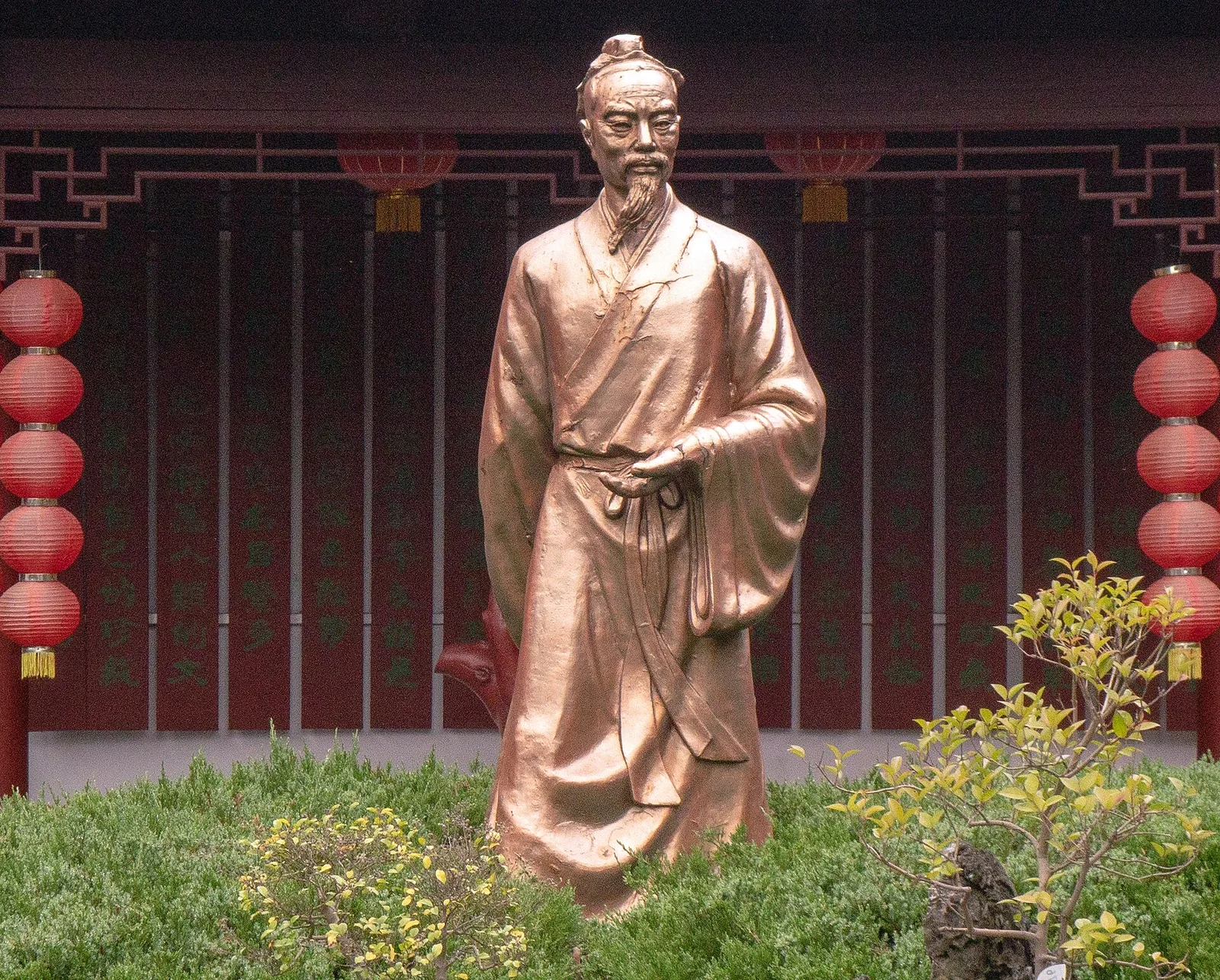
Photo: Wikimedia Commons · CC BY-SA 4.0

Full text
[1] “Among the Three Sovereigns, Shennong the Fiery Emperor; of the Zhou, the Duke of Zhou Dan of Lu; Yan Ying, prime minister of Qi; and of the Han, the immortals Dan Qiu-zi and Huangshan Jun.”
[2] “Shennong’s Classic of Food says: ‘Long use of cha and ming makes a person strong and gladens the spirit.’”
[3] “Yan Ying, when minister to Duke Jing of Qi, ate only husked-rice meals, with three roast game birds, five eggs, and tea-leaf vegetable.”
[4] “Sima Xiangru’s Fanyang pian lists among drugs wu-hui, jiegeng, yuanhua, kuandong, beimu, mubo, lou, qincao, shaoyao, gui, loulu, feilian, chuan-cha, bailian, baizhi, changpu, mangxiao, guan, jiao, and zhuyu.”
[5] “When Emperor Hui of Jin, fleeing in the dust, returned to Luoyang, the eunuch presented tea in an earthen bowl to the Son of Heaven.”
[6] “In the Jin, Lu Na, governor of Wuxing, when Xie An came to call, set out only tea and fruit.”
[7] “Zuo Si’s poem The Doting Daughters reads: ‘Their hearts race for the tea, they puff and blow upon the tripod.’”
[8] “Wang Meng of Jin loved tea, and pressed it on every visitor; the officials dreaded it, and whenever they meant to call they would say, ‘Today we must suffer the water-calamity.’”
[9] “In the Search for the Supernatural: Xia Houkai died of illness; his kinsman Gou Nu, who could see spirits, watched him come to fetch his horse and afflict his wife. Wearing a flat kerchief and single robe, he entered and sat on the great bed by the west wall where he had sat in life, and asked people for tea.”
Note
This chapter has 9 sections. The English text above is a working translation for discussion; the Chinese original is in the public domain. Name the edition when quoting, since Chapter One and several other chapters contain variants.
Source: Wikisource