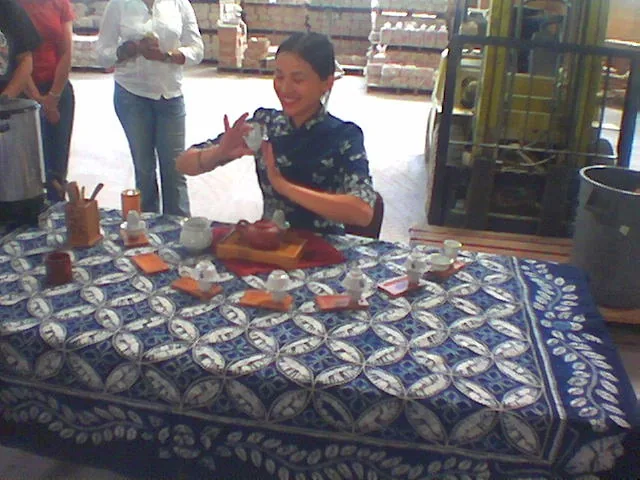
Photo: Wikimedia Commons · CC BY 2.0

Full text
[1] “Winged creatures fly, furred creatures run, and those with mouths speak — all three dwell between heaven and earth and live by drinking and eating. How far-reaching is the meaning of drinking!”
[2] “As a beverage, tea began with Shennong, the Divine Farmer, and became known through the Duke of Zhou of Lu.”
[3] “Some add scallion, ginger, jujube, tangerine peel, cornel, and mint, boiling it a hundred times, or stirring it slippery, or skimming off the froth. This is nothing but ditchwater — yet the custom persists.”
[4] “Alas! Heaven nurtures all things, and each has its utmost subtlety. Yet what men labor at is only the shallow and easy. They dwell in houses, and houses are refined to the utmost; they wear garments, and garments are refined to the utmost; they eat and drink, and food and wine are refined to the utmost.”
[5] “Those who cultivate tea may grow several hundred clumps; the tree like gualu, leaves like gardenia, flowers like white rose, fruit like palm.”
[6] “Tea has nine difficulties: the making, the judging, the vessels, the fire, the water, the roasting, the grinding, the brewing, and the drinking.”
[7] “Gathering in shade and roasting by night is not true making; tasting and sniffing is not true judging; rank-smelling vessels are not true utensils; greasy fuel and kitchen charcoal are not true fire; torrents and stagnant pools are not true water; raw within and scorched without is not true roasting; powder that flies like dust is not true grinding; clumsy hurried stirring is not true brewing; drinking only in summer is not true drinking.”
[8] “For tea of rare freshness and rich fragrance, pour but three bowls; for that of the second grade, five. With five guests, serve three bowls; with seven, five. With fewer than six, no fixed count is kept — but omit one, and let the finest essence make up his portion.”
Note
This chapter has 8 sections. The English text above is a working translation for discussion; the Chinese original is in the public domain. Name the edition when quoting, since Chapter One and several other chapters contain variants.
Source: Wikisource